
Mountaineering sleeping pads have come a long way since their introduction in 1966; materials have evolved and a wide variety of types has emerged, yet their primary purpose remains to protect the user from external elements, provide insulation from the ground, and offer a degree of comfort. A good sleeping pad not only ensures comfort but also serves as the essential insulating barrier between you and the cold ground when sitting or sleeping. Your choice of sleeping pad affects weight, warmth, comfort, and durability; make the wrong choice, and you will endure cold, miserable nights—regardless of how expensive your sleeping bag is.
Types of Mountaineering Sleeping Pads
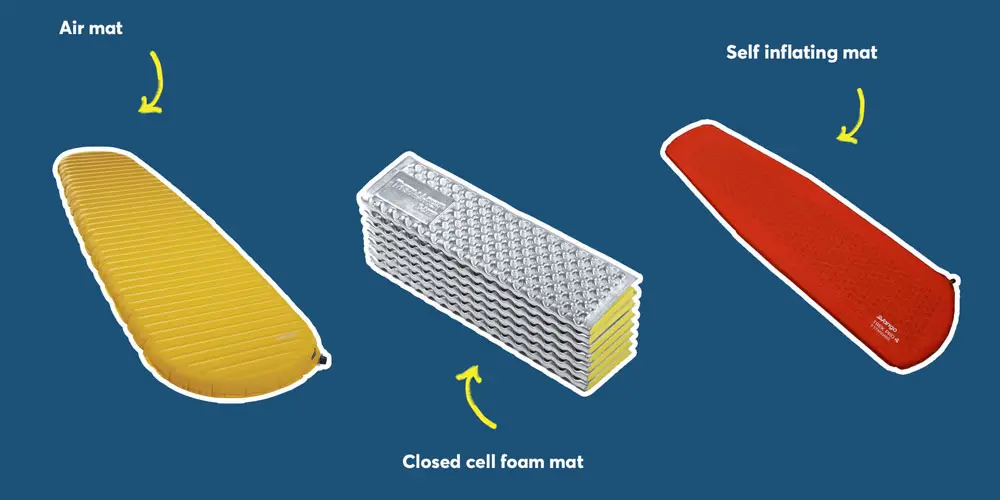
There are three main types of mountaineering and camping sleeping pads, each with its own distinct characteristics; the choice depends on your destination and the duration of your trip. Beyond the specific type, selecting the right pad involves considering factors such as durability, packability, weight, and insulation (R-value); these pads differ in these respects and are designed for various conditions.
1- Foam Mountaineering Mats
A foam mat is the most basic type of mountaineering sleeping pad; its key features are its light weight, high durability, and reasonable price. Essentially, it consists of a single, flat, rectangular piece of foam that provides cushioning and insulation between your body and the ground. Typically ranging from 1.5 to 4 centimeters in thickness, these mats come in various sizes to accommodate different body types and tent dimensions. They are made from dense foam that is both lightweight and inexpensive; however, they do not pack down into a very compact size. Generally, they are designed to either roll up or fold accordion-style, making them easy to carry due to their low weight.
Compared to previously invented standard soft foam, closed-cell foam mats offer a major advantage: non-absorbent cells. Thanks to this property, the mat does not absorb ground moisture, making it a suitable choice for resting and sleeping outdoors; however, due to inferior insulation, their use is recommended only during the summer.
2- Inflatable Mountaineering Mats
Available in a variety of shapes and sizes to suit diverse needs, inflatable sleeping pads have evolved over the years to become a popular choice among mountaineering mats. These air-filled pads—which can be inflated orally or via a built-in pump—are lightweight and exceptionally comfortable; once fully inflated, they are thicker than foam pads, offering superior cushioning on hard surfaces. They are also highly compact when packed, fitting easily into your mountaineering backpack.Inflatable mountaineering sleeping pads offer excellent insulation; when inflated, they create a thick, comfortable layer that can be adjusted to suit various sleeping positions. One drawback is that they are not always the most durable option and can be prone to punctures, so it is advisable to always carry a comprehensive repair kit. In terms of insulation, these types of sleeping pads fall into two categories:
✔ Insulated Inflatable Mats
These mountaineering sleeping pads offer the best performance across most criteria; they are often the warmest option, extremely lightweight, exceptionally comfortable, and pack down to a very small size. Their downsides are their relatively high price and the risk of puncture (though this issue is often far less of a problem than many people expect). For cold-weather camping, for users who prioritize gear weight, or for those who value comfort, these are the best sleeping pads available.
✔ Uninsulated Inflatable Mats
These sleeping pads are also incredibly lightweight and relatively comfortable; however, they offer minimal insulation and are highly prone to punctures. They are a good choice for mountaineering when minimizing gear weight is essential—particularly in situations where a pad failure would not be catastrophic, such as during certain adventure races or mountain marathons.
3- Self-inflating Mats
Self-inflating sleeping pads are durable mats constructed with foam cells that inflate when the valve is opened—automatically allowing air to enter—making them convenient to use while camping.Like other mountaineering sleeping pads, they come in various shapes and sizes—matched to your tent and insulation needs—but they are not as compact as inflatable pads.Self-inflating sleeping pads are significantly more comfortable than foam pads; they offer better insulation and warmth, with only a slight increase in weight. Their main advantage is ease of use: as the name suggests, they inflate automatically once the valve is opened, requiring only a few breaths to top them off.
Compared to foam hiking mats, self-inflating mats are slightly more prone to damage; while a foam mat remains usable even if punctured by a sharp object, this is often not the case with self-inflating models. Fortunately, repair kits designed for these mats allow you to avoid discarding a damaged one.
Result
When it comes to choosing between foam and inflatable mountaineering sleeping pads, the best option really depends on your personal needs and preferences. Generally, the suitable type of pad based on your style of mountaineering is outlined in the table below:
| Type and timing of the mountaineering trip | Suitable type of ground mat |
| Two- to three-day camping trip | Foam hiking mat |
| One-day nature excursion | Foam or self-inflating sleeping pad |
| Winter Mountaineering | Combination of foam and inflatable hiking mats |
Foam sleeping pads are lightweight, inexpensive, and durable, but they do not offer the same level of comfort as inflatable mountaineering pads. Inflatable pads provide greater comfort but are more expensive, require more effort to inflate and pack up, and are not as durable as foam pads.When you need an extra layer of insulation beneath your inflatable sleeping pad, a foam mat is an excellent choice; it boosts warmth and provides added support. Foam mats also serve as convenient seats for sitting on the ground anywhere, and they are a great option when you want to minimize the cost of your mountaineering gear.
An inflatable sleeping pad is the more common choice when a lightweight, portable mat is needed (for camping trips and long mountaineering expeditions), when insulation is required for cooler nights, and when comfort is prioritized over cost.
 Receiving information...